Temple of Kukulcán (El Castillo) Guide
Exploring the central solar pyramid, Maya calendar architecture, quetzal acoustics, and inner sanctuary secrets.
 Bestseller
Chichen Itza, Cenote & Valladolid Tour with Tequila and Lunch
 Likely to Sell Out
Early morning Chichen Itza Tour: Cenote and Tequila Tasting
 Top Rated
Chichen Itza, Cenote, and Valladolid Tour
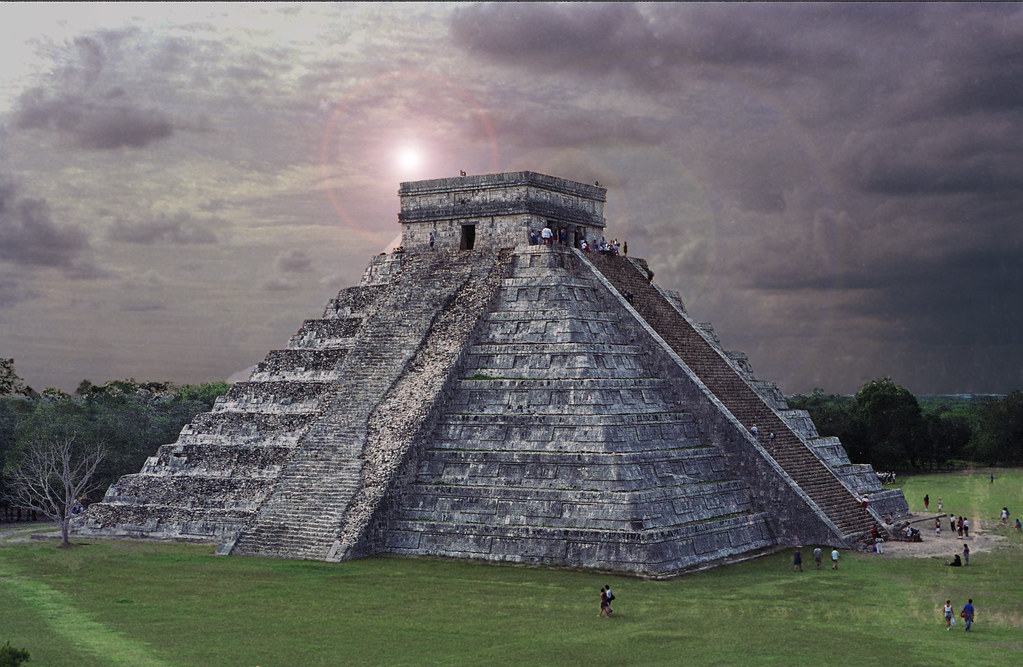
Astronomical Design & Calendar Geometry
The Temple of Kukulcán, named after the Maya feathered serpent deity, serves as the central focal point of Chichén Itzá. Rising 30 meters high over nine stepped terraces, the structure represents a masterwork of solar calendar alignment. Each face features a staircase of 91 steps, which combined with the top temple platform equals 365 steps—one for each day of the solar year.
Constructed between 800 AD and 1000 AD, the pyramid incorporates nine distinct horizontal terraces on each side, divided in half by the central staircases to form 18 terrace sections on each face. This corresponds directly to the 18 months of 20 days in the Haab' Maya solar calendar, supplemented by the 5-day ceremonial Wayeb' period. Additionally, the 52 carved panel reliefs on the pyramid base represent the 52-year cycle of the Maya Calendar Round when the solar Haab' and ritual Tzolk'in calendars realign.
The Solar Equinox Light & Shadow Phenomenon
Twice each year during the spring equinox (March 20–22) and autumn equinox (September 21–23), afternoon solar angles project seven isosceles triangles of light along the western side of the northern staircase. As the sun moves across the sky, these light triangles connect with the colossal carved stone serpent head at the base, creating the visual illusion of a 37-meter feathered serpent slithering down the pyramid to fertilize the earth.
This solar spectacle drew tens of thousands of Maya pilgrims anciently, and today attracts over 25,000 global travelers during peak equinox days. Solar rays hit the staircase angles starting around 3:30 PM, reaching peak shadow alignment between 4:15 PM and 4:30 PM before fading into dusk.
Acoustic Quetzal Chirp Resonance
Engineered into the limestone geometry of the northern staircase is a unique acoustic effect. When a visitor stands at the base of the staircase and claps their hands firmly, the sound echoes off the narrow stone risers, returning a high-pitched reverberation resembling the call of the Resplendent Quetzal bird—a species revered by Maya royalty for its iridescent green feathers.
Recent acoustic studies conducted by sound engineers confirm that the height, angle, and step depth were calculated deliberately to replicate bird vocalizations, demonstrating the sophisticated architectural physics possessed by Maya master builders.
Inside the Hidden Sub-Pyramid
In the 1930s, archaeological excavations led by Mexican researchers discovered that El Castillo was built directly on top of an earlier, smaller step pyramid dating to 600–800 AD. Traversing a narrow internal staircase, archaeologists revealed a secret inner sanctuary containing a carved limestone Chacmool statue with inlaid mother-of-pearl eyes, and a striking red jaguar throne encrusted with 74 polished jade disks forming its spots and jade spheres for its eyes.
While public access to the internal chamber was permanently closed in 2006 for conservation, replica models of the jade jaguar throne and Chacmool altar are displayed at the National Museum of Anthropology in Mexico City.
Comparison with Other Great Maya Pyramids
El Castillo differs in proportion and style from other Mesoamerican pyramids across the Yucatán Peninsula:
- Nohoch Mul (Cobá): Standing 42 meters tall, Cobá's main pyramid is taller than El Castillo but features steep, unadorned staircases built amid dense jungle.
- Pyramid of the Magician (Uxmal): Built in rounded Puuc style with elliptical terrace bases, contrasting with El Castillo's sharp rectangular symmetry.
- Great Temple (Ek Balam): Located 68 km northeast, Ek Balam's Acropolis features preserved plaster bas-relief tomb carvings and allows visitors to climb to the summit.
Conservation Laws & Visiting Guidelines
Climbing El Castillo or touching stone carvings has been strictly banned under Mexican federal law since 2006. Fines for crossing security ropes exceed $100 USD. For ideal photography, visit between 8:00 AM and 9:30 AM when morning sunlight illuminates the eastern and northern facades, or during golden hour after 4:00 PM.
Read about equinox event schedules in our equinox guide, review entrance prices on our entry fee page, or browse certified tour passes.